14.10.–11.11.2023
Chantal Kaufmann

Exhibition View


D
CODEC
Wenn ich an Chantal Kaufmanns filmische Praxis denke, so bilden Diskontinuität/Unterbrechung ein wiederholendes und somit formgebendes Prinzip. Die Illusion des Films und das ichzentrierte Bewusstsein werden durch diskontinuierlich auftauchende Filmbilder gestört. Bei Kaufmann wird aber genau diese Unterbrechung zum Flow.
Ausserhalb des logozentrischen Käfigs wird, mittels Kaufmanns spezifischen Einsatz von Text, Sound und Schnitt ein ganz bestimmter Rhythmus hergestellt. Ein Fluss.
Kein Vermessen der visuellen Welt, kein Ich sehe, sondern Es zeigt.
Das was aufbricht – uns latent gegenwärtig ist (von früher) oder im Traum: ein Gleiten.*
Ein umherschweifendes, Oberflächen absuchendes, Tiefenstrukturen durchbohrendes, doch niemals erfassendes Schauen.
Diskontinuität manifestiert sich hierbei eben nicht als Stillstand, sondern in der Wiederholung dieses eigentümlichen Taktes.
In Abwesenheit einer Ton- oder Filmspur, taucht Rhythmus als räumliches Prinzip in CODEC auf. (Abgesehen davon, dass der Titel buchstäblich zu rhythmischen Spielen verleitet: ein niemals enden wollendes C-O-D-E-C-O-D-E-C-O-D-E-C... wäre genauso vorstellbar wie eine Reihe unterschiedlicher Formationen D-E-C-O-D-E; C-O-D-E; D-E-C-O, etc.)
Codec bezeichnet im IT Bereich ein Algorithmenpaar, welches Daten oder Signale kodiert und dekodiert. Ein Encoder bildet mit möglichen weiteren Decodern eine logische Funktionskette. Beispiel für ein Codec ist die Komprimierung einer Video-/Mediendatei zur Verringerung ihrer Datengrösse. Der Codec ist dabei zugleich Methode und Ort dieser Transformation. Hierbei kann es zu Verlusten (bei der Bild und Tonqualität aber auch bei der Kontinuität und Wiedergabe) kommen. Die Zeit, die zur Komprimierung, Übertragung, Dekomprimierung und Wiedergabe der Videodaten benötigt wird, bezeichnet man als Latenz (etwas, was bereits vorhanden ist aber noch nicht in Erscheinung treten kann).
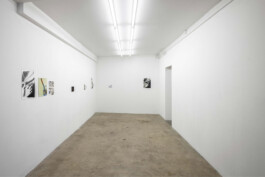
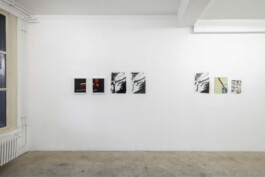
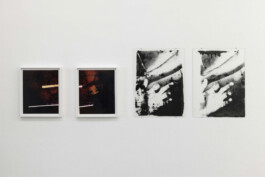
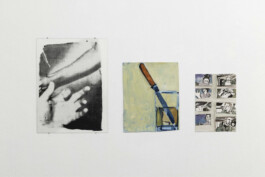
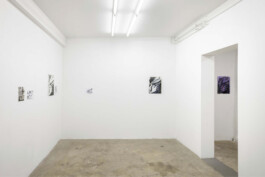
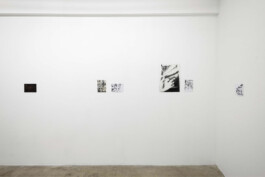
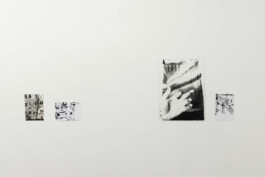
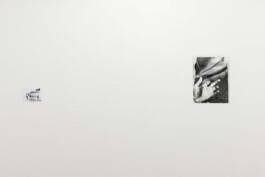
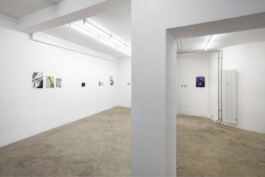
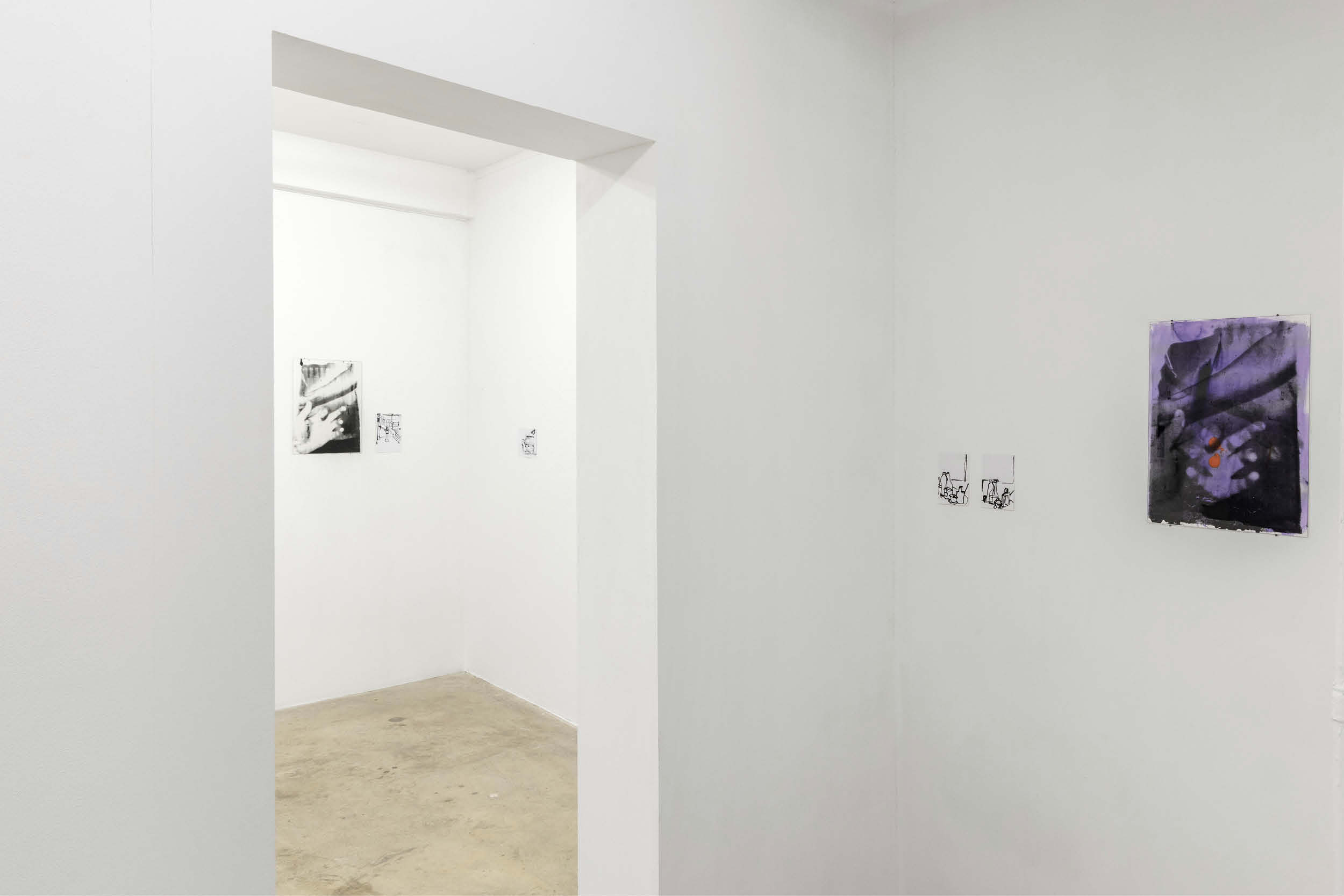
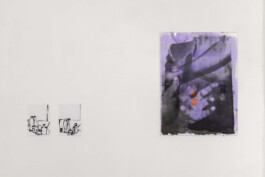
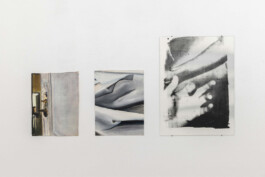
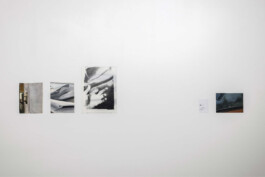
Versuchen wir nun also die Ausstellung als Codec zu verstehen, so könnte man den Raum als Dateicontainer auffassen, die gezeigten Werke als umzuwandelnde Dateien. Durch die lineare Hängung der einzelnen auf unterschiedlichen Formaten und Medien basierenden Werke, wird eine räumliche Abfolge als Narration evoziert. Das lineare „Lesen“ wird jedoch immer wieder durch das Auftauchen eines Siebdruckes einer fassenden Hand zerstört, sowie durch die unterschiedlich grossen Abstände zwischen den einzelnen Werken. Aber auch hier manifestiert sich das Prinzip der Wiederholung, als Stütze des Flows. Es scheint als wären es diese Hände, die als Tarnung, Umdeutung oder Neuverbindung die Logik einer Funktionskette für ihre Encoder resp. Decoder produzieren.
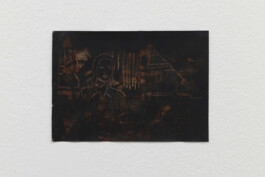
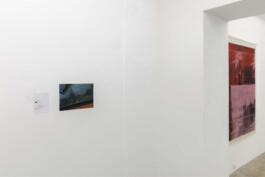
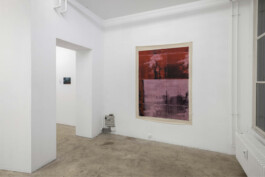
Die anziehende purpurrote Rose (Crimson Joy I, 2023) taucht ebenfalls wieder auf. Wir kennen das Motiv aus Kaufmanns parallel laufender Ausstellung off they go in der Kirchgasse Galerie in Steckborn, wo wir erfahren, dass sich in ihr die Latenz des Wurms verbirgt.**
Damit wäre der Rahmen des Codecs auch räumlich gesprengt.
Nicht nur die Latenz des Wurms erinnert an die Ausstellung in Steckborn, sondern auch die beiden Photogramme aus der Serie Big A little a, die einzigen Werke in der Ausstellung wo Lettern auftauchen. Die Buchstabenanhäufung in Big A little a, n1, 2022 und Big A little a, n2, 2022 bilden gemeinsam mit dem Wurm den Anfang resp. das Ende der Ausstellung. Die Latenz steht also am Anfang vom Ende. Da, wo es eine kleine Öffnung gibt – ansonsten kämen wir zum Stillstand.
Hey, oh, oh, hey, es gibt doch noch eine andere Repräsentation von Sprache, angedeutet durch offene Mäuler in Kaufmanns malerischer Übertragung des Musikvideos Say It Right (Nelly Furtado feat. Timbaland & Justin Timberlake):
....
No, you don't mean nothing at all to me (Hey, oh, oh, hey)
But you got what it takes to set me free (Hey, oh, oh, hey)
Oh, you could mean everything to me (Hey, oh, oh, hey)
....
*Vgl. Jacques Lacan, Die Spaltung von Auge und Blick, aus Die vier Grundbegriffe der Psychoanalyse. Das Seminar Buch XI, Weinheim/Berlin 1996, S. 71-126.
**Chantal Kaufmanns verweist mit der Einladungskarte ihrer Ausstellung in Steckborn auf ein Gedicht The Sick Rose (1789) von William Blake. Das Gedicht handelt von einem Wurm, der sich aus Liebe und Anziehung in einer purpurroten Rose eingenistet hat, worauf diese erkrankt und abstirbt.
Text DE: Lucie Pia
E
CODEC
When I think of Chantal Kaufmann's cinematic practice, discontinuity/interruption forms a recurring and thus formative principle. The illusion of film and the ego-centered consciousness are disrupted by film images that appear discontinuously. In Kaufmann's work, however, it is precisely this interruption that becomes the flow.
Outside the logocentric cage, through Kaufmann's distinct use of text, sound and editing, a specific rhythm is created. A flow.
Not a measuring of the visual world, not an I see but an Id shows.
That which breaks open – is latent within us (from the past) or in a dream: a sliding.*
A wandering, surface-searching, depth-penetrating, yet never capturing gaze.
Discontinuity manifests itself here not as a standstill, but in the repetition of this peculiar rhythm.
In the absence of an audio or film track, rhythm appears as a spatial principle in CODEC.
(Apart from the fact that the title literally invites you to play rhythmic games: a never-ending C-O-D-E-C-O-D-E-C-O-D-E-C-O-D-E-C... would be just as imaginable as a series of different formations D-E-C-O-D-E; C-O-D-E; D-E-C-O, etc.).
The term codec refers in the IT sector to a pair of algorithms that encode and decode data or signals. An encoder, along with possible decoders, forms a logical chain of functions.
An example of a codec is the compression of a video or media file to reduce its data size. The codec is both the method and the location of this transformation. This process can result in losses, both in terms of image and sound quality and in terms continuity and playback. The time required for the compression, transmission, decompression, and playback of video data is referred to as latency. (Something that already exists but cannot yet come into appearance).
If we now attempt to understand the exhibition as a codec, the space could be considered as a file container, the exhibited works as files to be converted. The linear hanging of the individual works, based on different formats and media, evokes a spatial sequence as a narrative. However, the linear "reading" is repeatedly disrupted by the appearance of a silkscreen print depicting a grasping hand, as well as by the varying distances between the individual works. Yet, even here, the principle of repetition manifests itself as support for the flow. It seems as if it is these hands, as camouflage, reinterpretation, or reconnection, produce the logic of a functional chain for their encoders or decoders.
The captivating crimson rose (Crimson Joy I, 2023) reappears as well. We are familiar with this motif from Kaufmann's parallel exhibition off they go at the Kirchgasse gallery in Steckborn, where we learn that the rose conceals the latency of the worm.**
Thus, the scope of the codec is cracked open also in spatial terms.
Not only the latency of the worm is reminiscent of the exhibition in Steckborn, but also the two photograms from the series Big A little a, the only works in the exhibition where letters appear. The accumulation of letters in Big A little a, n1, 2022 and Big A little a, n2, 2022, together with the worm, form the beginning and the end of the exhibition respectively. The latency is therefore at the beginning of the end. Where there is a small opening – otherwise we would come to a standstill.
Hey, oh, oh, hey, there is indeed another representation of language, hinted at by open mouths in Kaufmann's painterly interpretation of the music video Say It Right (Nelly Furtado feat. Timbaland & Justin Timberlake):
....
No, you don't mean nothing at all to me (Hey, oh, oh, hey)
But you got what it takes to set me free (Hey, oh, oh, hey)
Oh, you could mean everything to me (Hey, oh, oh, hey)
....
*See: Jacques Lacan, Die Spaltung von Auge und Blick, in: Die vier Grundbegriffe der Psychoanalyse. Das Seminar Buch XI, Weinheim/Berlin 1996, p. 71-126.
**Chantal Kaufmanns refers to a poem The Sick Rose (1789) by William Blake on the invitation card of her exhibition in Steckborn. The poem is about a worm that nested in a purple rose out of love and attraction, whereupon the rose became ill and died.
Text EN: Lucie Pia
Mit freundlicher Unterstützung von/Kindly supported by:
Pro Helvetia | Kultur Stadt Bern | Swisslos Lotteriefonds Kanton Bern | Burgergemeinde Bern | Temperatio | GVB Kulturstiftung
Back to top
14.10.–11.11.2023
Chantal Kaufmann

Exhibition View


D
CODEC
Wenn ich an Chantal Kaufmanns filmische Praxis denke, so bilden Diskontinuität/Unterbrechung ein wiederholendes und somit formgebendes Prinzip. Die Illusion des Films und das ichzentrierte Bewusstsein werden durch diskontinuierlich auftauchende Filmbilder gestört. Bei Kaufmann wird aber genau diese Unterbrechung zum Flow.
Ausserhalb des logozentrischen Käfigs wird, mittels Kaufmanns spezifischen Einsatz von Text, Sound und Schnitt ein ganz bestimmter Rhythmus hergestellt. Ein Fluss.
Kein Vermessen der visuellen Welt, kein Ich sehe, sondern Es zeigt.
Das was aufbricht – uns latent gegenwärtig ist (von früher) oder im Traum: ein Gleiten.*
Ein umherschweifendes, Oberflächen absuchendes, Tiefenstrukturen durchbohrendes, doch niemals erfassendes Schauen.
Diskontinuität manifestiert sich hierbei eben nicht als Stillstand, sondern in der Wiederholung dieses eigentümlichen Taktes.
In Abwesenheit einer Ton- oder Filmspur, taucht Rhythmus als räumliches Prinzip in CODEC auf. (Abgesehen davon, dass der Titel buchstäblich zu rhythmischen Spielen verleitet: ein niemals enden wollendes C-O-D-E-C-O-D-E-C-O-D-E-C... wäre genauso vorstellbar wie eine Reihe unterschiedlicher Formationen D-E-C-O-D-E; C-O-D-E; D-E-C-O, etc.)
Codec bezeichnet im IT Bereich ein Algorithmenpaar, welches Daten oder Signale kodiert und dekodiert. Ein Encoder bildet mit möglichen weiteren Decodern eine logische Funktionskette. Beispiel für ein Codec ist die Komprimierung einer Video-/Mediendatei zur Verringerung ihrer Datengrösse. Der Codec ist dabei zugleich Methode und Ort dieser Transformation. Hierbei kann es zu Verlusten (bei der Bild und Tonqualität aber auch bei der Kontinuität und Wiedergabe) kommen. Die Zeit, die zur Komprimierung, Übertragung, Dekomprimierung und Wiedergabe der Videodaten benötigt wird, bezeichnet man als Latenz (etwas, was bereits vorhanden ist aber noch nicht in Erscheinung treten kann).
Versuchen wir nun also die Ausstellung als Codec zu verstehen, so könnte man den Raum als Dateicontainer auffassen, die gezeigten Werke als umzuwandelnde Dateien. Durch die lineare Hängung der einzelnen auf unterschiedlichen Formaten und Medien basierenden Werke, wird eine räumliche Abfolge als Narration evoziert. Das lineare „Lesen“ wird jedoch immer wieder durch das Auftauchen eines Siebdruckes einer fassenden Hand zerstört, sowie durch die unterschiedlich grossen Abstände zwischen den einzelnen Werken. Aber auch hier manifestiert sich das Prinzip der Wiederholung, als Stütze des Flows. Es scheint als wären es diese Hände, die als Tarnung, Umdeutung oder Neuverbindung die Logik einer Funktionskette für ihre Encoder resp. Decoder produzieren.
Die anziehende purpurrote Rose (Crimson Joy I, 2023) taucht ebenfalls wieder auf. Wir kennen das Motiv aus Kaufmanns parallel laufender Ausstellung off they go in der Kirchgasse Galerie in Steckborn, wo wir erfahren, dass sich in ihr die Latenz des Wurms verbirgt.**
Damit wäre der Rahmen des Codecs auch räumlich gesprengt.
Nicht nur die Latenz des Wurms erinnert an die Ausstellung in Steckborn, sondern auch die beiden Photogramme aus der Serie Big A little a, die einzigen Werke in der Ausstellung wo Lettern auftauchen. Die Buchstabenanhäufung in Big A little a, n1, 2022 und Big A little a, n2, 2022 bilden gemeinsam mit dem Wurm den Anfang resp. das Ende der Ausstellung. Die Latenz steht also am Anfang vom Ende. Da, wo es eine kleine Öffnung gibt – ansonsten kämen wir zum Stillstand.
Hey, oh, oh, hey, es gibt doch noch eine andere Repräsentation von Sprache, angedeutet durch offene Mäuler in Kaufmanns malerischer Übertragung des Musikvideos Say It Right (Nelly Furtado feat. Timbaland & Justin Timberlake):
....
No, you don't mean nothing at all to me (Hey, oh, oh, hey)
But you got what it takes to set me free (Hey, oh, oh, hey)
Oh, you could mean everything to me (Hey, oh, oh, hey)
....
*Vgl. Jacques Lacan, Die Spaltung von Auge und Blick, aus Die vier Grundbegriffe der Psychoanalyse. Das Seminar Buch XI, Weinheim/Berlin 1996, S. 71-126.
**Chantal Kaufmanns verweist mit der Einladungskarte ihrer Ausstellung in Steckborn auf ein Gedicht The Sick Rose (1789) von William Blake. Das Gedicht handelt von einem Wurm, der sich aus Liebe und Anziehung in einer purpurroten Rose eingenistet hat, worauf diese erkrankt und abstirbt.
Text DE: Lucie Pia
E
CODEC
When I think of Chantal Kaufmann's cinematic practice, discontinuity/interruption forms a recurring and thus formative principle. The illusion of film and the ego-centered consciousness are disrupted by film images that appear discontinuously. In Kaufmann's work, however, it is precisely this interruption that becomes the flow.
Outside the logocentric cage, through Kaufmann's distinct use of text, sound and editing, a specific rhythm is created. A flow.
Not a measuring of the visual world, not an I see but an Id shows.
That which breaks open – is latent within us (from the past) or in a dream: a sliding.*
A wandering, surface-searching, depth-penetrating, yet never capturing gaze.
Discontinuity manifests itself here not as a standstill, but in the repetition of this peculiar rhythm.
In the absence of an audio or film track, rhythm appears as a spatial principle in CODEC.
(Apart from the fact that the title literally invites you to play rhythmic games: a never-ending C-O-D-E-C-O-D-E-C-O-D-E-C-O-D-E-C... would be just as imaginable as a series of different formations D-E-C-O-D-E; C-O-D-E; D-E-C-O, etc.).
The term codec refers in the IT sector to a pair of algorithms that encode and decode data or signals. An encoder, along with possible decoders, forms a logical chain of functions.
An example of a codec is the compression of a video or media file to reduce its data size. The codec is both the method and the location of this transformation. This process can result in losses, both in terms of image and sound quality and in terms continuity and playback. The time required for the compression, transmission, decompression, and playback of video data is referred to as latency. (Something that already exists but cannot yet come into appearance).
If we now attempt to understand the exhibition as a codec, the space could be considered as a file container, the exhibited works as files to be converted. The linear hanging of the individual works, based on different formats and media, evokes a spatial sequence as a narrative. However, the linear "reading" is repeatedly disrupted by the appearance of a silkscreen print depicting a grasping hand, as well as by the varying distances between the individual works. Yet, even here, the principle of repetition manifests itself as support for the flow. It seems as if it is these hands, as camouflage, reinterpretation, or reconnection, produce the logic of a functional chain for their encoders or decoders.
The captivating crimson rose (Crimson Joy I, 2023) reappears as well. We are familiar with this motif from Kaufmann's parallel exhibition off they go at the Kirchgasse gallery in Steckborn, where we learn that the rose conceals the latency of the worm.**
Thus, the scope of the codec is cracked open also in spatial terms.
Not only the latency of the worm is reminiscent of the exhibition in Steckborn, but also the two photograms from the series Big A little a, the only works in the exhibition where letters appear. The accumulation of letters in Big A little a, n1, 2022 and Big A little a, n2, 2022, together with the worm, form the beginning and the end of the exhibition respectively. The latency is therefore at the beginning of the end. Where there is a small opening – otherwise we would come to a standstill.
Hey, oh, oh, hey, there is indeed another representation of language, hinted at by open mouths in Kaufmann's painterly interpretation of the music video Say It Right (Nelly Furtado feat. Timbaland & Justin Timberlake):
....
No, you don't mean nothing at all to me (Hey, oh, oh, hey)
But you got what it takes to set me free (Hey, oh, oh, hey)
Oh, you could mean everything to me (Hey, oh, oh, hey)
....
*See: Jacques Lacan, Die Spaltung von Auge und Blick, in: Die vier Grundbegriffe der Psychoanalyse. Das Seminar Buch XI, Weinheim/Berlin 1996, p. 71-126.
**Chantal Kaufmanns refers to a poem The Sick Rose (1789) by William Blake on the invitation card of her exhibition in Steckborn. The poem is about a worm that nested in a purple rose out of love and attraction, whereupon the rose became ill and died.
Text EN: Lucie Pia
Mit freundlicher Unterstützung von/Kindly supported by:
Pro Helvetia | Kultur Stadt Bern | Swisslos Lotteriefonds Kanton Bern | Burgergemeinde Bern | Temperatio | GVB Kulturstiftung
Back to top